


Views: 0 Author: Site Editor Publish Time: 2026-05-15 Origin: Site


In chemical processing, filtration is not only about removing particles. It is closely related to product purity, equipment protection, operating stability, and maintenance cost. Choosing the wrong filter element may cause short service life, unstable pressure drop, particle bypass, frequent replacement, or contamination of downstream equipment.
Traditional filter cartridges and sintered metal filters are both useful in industrial filtration. However, they are designed for different operating conditions. The best choice depends on temperature, pressure, chemical compatibility, filtration accuracy, cleaning method, and total lifecycle cost.
This article compares sintered metal filters with traditional filter cartridges and explains when each option is more suitable.
Traditional filter cartridges are commonly made from polymer media, paper, fiberglass, pleated materials, or wire mesh. They are widely used because they are easy to install, easy to replace, and often have a lower initial cost.
Common traditional cartridge materials include:
· Polypropylene
· Polyester
· Nylon
· PTFE
· Fiberglass
· Paper
· Woven wire mesh
For clean liquids, moderate temperature, low pressure, and non-corrosive media, traditional filter cartridges can be an economical and practical choice.
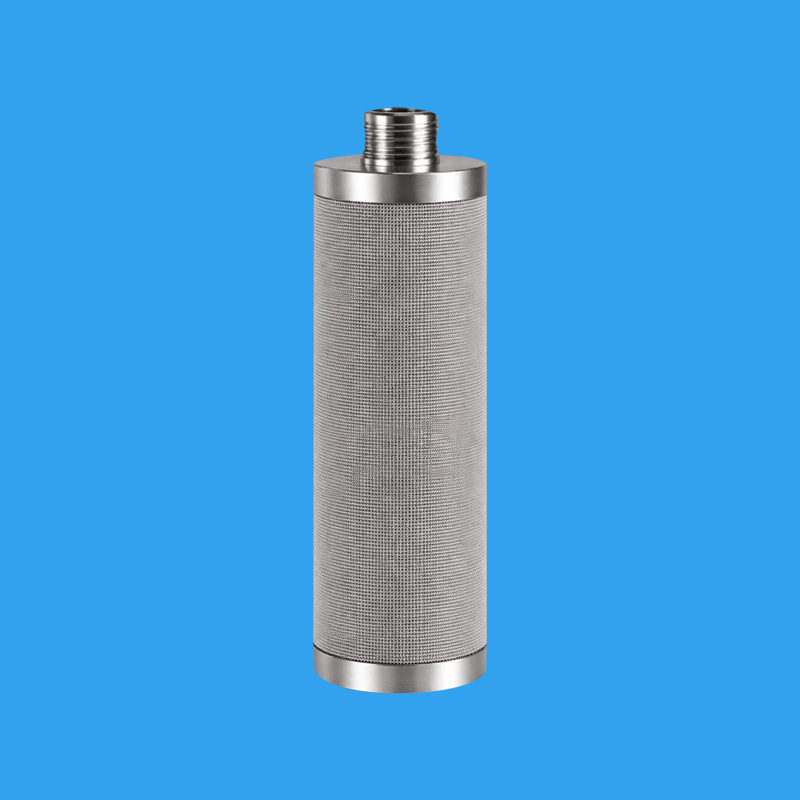
A sintered metal filter is a porous metal filter element made from sintered metal powder, metal fiber felt, or multi-layer wire mesh. The sintering process bonds the metal particles, fibers, or mesh layers together, creating a rigid and self-supporting structure.
Sintered metal filters are designed for demanding industrial applications where higher strength, better temperature resistance, corrosion resistance, and repeated cleaning are required.
They are commonly used in chemical processing, petrochemical plants, refineries, high-temperature gas filtration, catalyst recovery, polymer filtration, and other severe service applications.
1. Mechanical Strength
Traditional polymer or fiberglass cartridges may deform, collapse, or tear under high differential pressure or pressure fluctuation. This can lead to particle bypass and unstable filtration performance.
Sintered metal filters have a rigid metallic structure. They provide better resistance to pressure, vibration, and repeated cleaning cycles. This makes them more suitable for high-pressure or high-stress industrial applications.
2. Temperature Resistance
Temperature is one of the biggest differences between traditional cartridges and sintered metal filters.
Many polymer filter cartridges have limited temperature resistance. At elevated temperatures, they may soften, shrink, or lose strength.
Sintered metal filters can operate at much higher temperatures when the correct alloy is selected.stainless steel sintered filter are suitable for many medium- and high-temperature applications. For more severe conditions, special alloys such as Hastelloy, Inconel, or other nickel-based alloys can be used.
In selected high-temperature applications, special alloy sintered metal filters can be designed for service temperatures up to 900°C.
3. Chemical Compatibility
Traditional cartridges may be limited by chemical compatibility. Some polymers can swell, soften, or degrade when exposed to solvents, acids, alkalis, or aggressive chemical media.
Sintered metal filters can be manufactured from different alloys to match specific chemical environments. 316L stainless steel is commonly used for general chemical applications, while Hastelloy, Inconel, titanium, or other alloys can be selected for more corrosive conditions.
Correct material selection is essential for both traditional cartridges and metal filters.
4. Filtration Stability
Traditional soft media may change shape under pressure or flow variation. In some conditions, this may affect filtration accuracy.
Sintered metal filters have a fixed pore structure. The pores do not easily stretch or deform during operation. This helps maintain stable filtration performance, especially in demanding process conditions.
5. Cleanability and Reuse
Many traditional filter cartridges are disposable. Once blocked, they must be replaced. This is acceptable in low-cost or non-critical applications, but it can become expensive in continuous industrial processes.
Sintered metal filters can often be cleaned and reused. Depending on the contamination type, cleaning methods may include backwashing, reverse gas blowback, ultrasonic cleaning, chemical soaking, or thermal cleaning.
This reusable design can reduce replacement frequency and lower long-term maintenance cost in suitable applications.
6. Initial Cost and Lifecycle Cost
Traditional filter cartridges usually have a lower initial purchase cost. This makes them attractive for simple filtration duties and low-risk applications.
Sintered metal filters usually have a higher initial cost because of their material and manufacturing process. However, they may reduce long-term cost by offering longer service life, repeated cleaning, lower replacement frequency, and reduced downtime.
For critical production systems, lifecycle cost is often more important than unit price.
Comparison Table
Item | Traditional Filter Cartridge | Sintered Metal Filter |
Initial cost | Lower | Higher |
Mechanical strength | Moderate to low | High |
Temperature resistance | Limited by media | High, depending on alloy |
Chemical resistance | Depends on polymer/media | Depends on alloy |
Cleanability | Usually limited | Good, reusable |
Service life | Shorter in harsh conditions | Longer in suitable applications |
Pressure resistance | Limited | Strong |
Media shedding risk | Possible for some media | Very low |
Best use | Mild or general filtration | Severe industrial filtration |
Traditional filter cartridges may be a better choice when:
· Operating temperature is moderate
· Pressure is low or stable
· The media is not highly corrosive
· Replacement is easy and low-cost
· The application is not critical
· Disposable operation is acceptable
· Initial cost is the main concern
They are suitable for general water filtration, pre-filtration, low-temperature chemical filtration, and many utility applications.
No single filter fits every scenario. Process engineers must match the technology to the specific environmental demands. We built this framework to clarify the decision process.
· The process involves high temperature
· The media is corrosive or aggressive
· The system has high differential pressure
· Pressure pulses or flow reversals are present
· The filter must be cleaned and reused
· Particle bypass may damage downstream equipment
· Long service life is required
· Stable filtration performance is critical
· Maintenance downtime is costly
They are commonly used in refinery, petrochemical, chemical, power, and high-temperature gas filtration systems.
Important Selection Factors
Before selecting a filter, users should evaluate the following parameters:
· Process media
· Chemical composition
· Operating temperature
· Operating pressure
· Flow rate
· Particle size distribution
· Required filtration rating
· Solid concentration
· Allowable pressure drop
· Cleaning method
· Material compatibility
· Housing design and connection type
A filter should not be selected only by micron rating or unit price. The final choice should consider operating reliability, cleanability, service life, and total cost.
There is no single filter element that is best for every chemical process. Traditional filter cartridges are practical and economical for mild operating conditions. They are easy to replace and suitable for many general filtration applications.
Sintered metal filters are better suited for severe industrial conditions involving high temperature, high pressure, corrosive media, repeated cleaning, or long service life requirements. Although the initial cost is higher, their strength, cleanability, and durability can provide significant advantages in demanding chemical processing applications.
For critical filtration systems, the best approach is to evaluate process conditions carefully and select the filter material, structure, and filtration rating according to actual operating data.
Berae can provide customized sintered metal filter elements according to your process media, temperature, pressure, flow rate, filtration rating, and cleaning requirements.
Are sintered metal filters always better than traditional filter cartridges?
No. Traditional filter cartridges are suitable for many mild and general applications. Sintered metal filters are more suitable for harsh conditions where strength, temperature resistance, corrosion resistance, and reusability are required.
Can sintered metal filters replace polymer filter cartridges?
In many industrial applications, yes. However, the replacement should be evaluated according to filter housing size, flow rate, pressure drop, filtration rating, sealing method, and material compatibility.
Are sintered metal filters more expensive?
The initial cost is usually higher than disposable cartridges. However, in suitable applications, repeated cleaning and longer service life may reduce long-term operating cost.
What materials are available for sintered metal filters?
Common materials include 304 stainless steel, 316L stainless steel, Hastelloy, Inconel, Monel, titanium, and other special alloys.
How should I choose between a traditional cartridge and a sintered metal filter?
You should consider temperature, pressure, corrosion, filtration accuracy, cleaning method, downtime cost, and service life. For severe or critical applications, sintered metal filters are often the more reliable choice.


